Monday, June 28, 2010

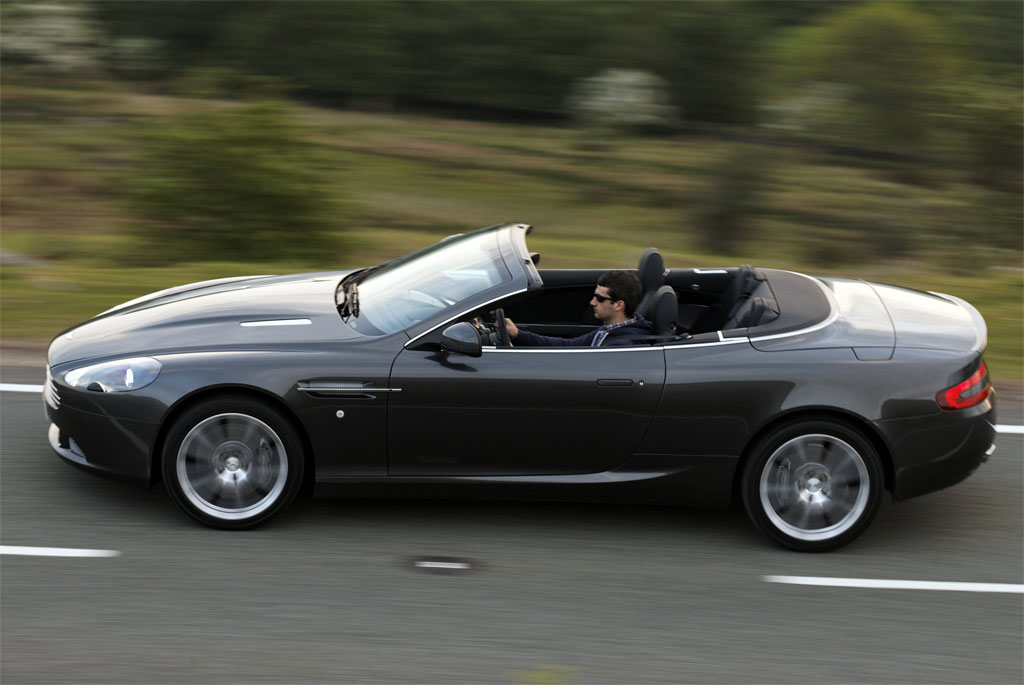
Preview: 2011 Aston Martin DB9


Aston Martin is set to start deliveries of its new DB9 model next month after the highly desirable car received its most significant upgrade since its world debut in 2003.

The exterior styling changes of the 2011 Aston Martin DB9
include a new front bumper, bright finish radiator grille and a reshaped lower intake. The can also comes with new headlight bezels and clear rear light lenses, new sills, silver brake calipers, 20-spoke alloy wheels.

There’s a new front bumper and the grill gets a bit of sparkle. The lower intake gets a re-shape and a bit of bright hexagonal mesh and there’s new headlight bexels. The sills get a re-shape, there’s new alloys, silver brake callipers and clear light lenses. And that’s it. As we said – new makeup, not a stretched and manic looking Florida facelift.

The Aston Martin DB9 is available as either Coupe or Volante (convertible) with rear mid-mounted six-speed manual gearbox as standard or optional ‘Touchtronic 2’ six-speed automatic transmission. Production of the revised DB9 is already underway, with deliveries commencing in July. Prices start from £122,445 for the DB9 Coupe and £131,445 for the DB9 Volante.


2011 Aston Martin DB9 2011 Aston Martin DB9 2011 Aston Martin DB9 2011 Aston Martin DB9 2011 Aston Martin DB9 2011 Aston Martin DB9 2011 Aston Martin DB9


Press Release

In the most significant programme of upgrades since its world debut in 2003, Aston Martin DB9 range has received a complete package of styling, engineering and equipment enhancements.

As the most successful Aston Martin of all-time (an honour it shares with the V8 Vantage) the DB9 has established itself as the definitive grand tourer, thanks to an enduring combination of understated elegance, sporting character and genuine luxury.

For Dr Ulrich Bez, Aston Martin's Chief Executive, the Aston Martin DB9 remains a very special car: "The DB9 is the quintessential sporting grand tourer and offers an unrivalled combination of driver involvement, character, luxury and refinement. This car combines our unique Aston Martin character with an uncompromised design philosophy, craftsmanship and trademark Aston Martin performance ability."

This new package of improvements compliments these core qualities perfectly. Subtle styling changes freshen the Aston Martin DB9's appearance, with a new front bumper, bright finish radiator grille and a re-shaped lower intake featuring bright hexagonal mesh. New headlight bezels, re-styled sills, silver brake calipers, 20-spoke diamond turned alloy wheels and clear rear light lenses complete the external revisions.

Under the skin the Aston Martin DB9's passive damping system has been replaced by a new Adaptive Damping System (ADS), which offers enhanced ride comfort together with sharper handling when switched to Sport mode. The ADS system is offered as standard equipment across the Aston Martin DB9 range, encompassing both Coupe and Volante (convertible). A new tyre pressure monitoring system, a revised Bluetooth microphone system and the addition of a new Double Apex alloy finish trim and Bang & Olufsen hi-fi options broaden the Aston Martin DB9's specification.

Aston Martin's Product Development Director, Ian Minards, explains that it is all part of an ongoing commitment to continual improvement: "The Aston Martin DB9 was the first car built at Gaydon adopting the VH architecture. It has evolved every year since, with significant changes including a power upgrade and successive reductions in CO2 emissions. The latest package of improvements goes further than ever, highlighting the Aston Martin DB9's qualities as a true sporting GT and underlining its role as the backbone car of our range."

The Aston Martin DB9 is available as either Coupe or Volante (convertible) with rear mid-mounted six-speed manual gearbox as standard or optional 'Touchtronic 2' six-speed automatic transmission. Production of the revised Aston Martin DB9 is already underway, with deliveries commencing in July. Prices start from £122,445 for the Aston Martin DB9 Coupe and £131,445 for the Aston Martin DB9 Volante.

Background

The introduction of the DB9 marked the beginning of Aston Martin's 21st Century renaissance. The first new model to be built at Aston Martin's headquarters in Gaydon, Warwickshire, and the first to be built around Aston Martin's rigid, lightweight, bonded aluminium VH architecture; the Aston Martin DB9 was an immediate and unparalleled success, setting a new tone for Aston Martins of the future.

Since its launch in 2003 some 12,500 DB9s have been produced and delivered to customers in 34 countries. This establishes it as the most successful Aston Martin model of all-time (jointly with the V8 Vantage), surpassing total sales of the DB7. Current Aston Martin DB9 production volume is around 1,500 cars per year.

Engineering

Since the DB9's introduction Aston Martin has demonstrated the versatility of the VH architecture by developing the Vantage, DBS and Rapide model ranges. In the process Aston Martin's engineers have gained an increasingly detailed understanding of the VH platform, which in turn has led to the constant improvement and evolution of existing established models.

In this latest package of improvements for Aston Martin DB9, hardware changes focus on the chassis, featuring a standard Adaptive Damping System (ADS) which offers a system constantly evaluating the optimum damper condition, similar to that seen on the DBS and Rapide models. Controlled by a button on the centre console, the two-stage adaptive dampers can be switched between their default mode, which is optimised for ride comfort, and a firmer sport mode, which delivers tighter body control and a more responsive feel. Such is the success of the Aston Martin DB9's new damping system that the DB9 Sport Pack upgrade has now been discontinued. However a Sport design alloy wheel is available as an option.

Performance comes courtesy of Aston Martin's celebrated 6.0-litre V12 engine, which develops an unchanged 470bhp and 442lb ft of torque. Mated to a choice of six-speed 'Touchtronic' paddle-shift automatic or six-speed H-pattern manual transmissions, the Aston Martin DB9 offers an intoxicating blend of effortless pace and sporting character. A top speed of 190mph and the ability to hit 60mph in just 4.6sec seal its credentials as the definitive 2+2 Grand Tourer.

Design

Improving upon what many consider to be one of the most beautiful cars in the world is a delicate exercise. According to Aston Martin's Director of Design, Marek Reichman, subtlety and fine attention to detail is the key: "The beauty of an Aston Martin comes from harmonious proportions, a ground-hugging stance, taut surfacing and a complete and thorough attention to detail. The Aston Martin DB9 epitomises these qualities; it is beautiful but subtle - not attention seeking."

At the front a new bumper is the main change, with a re-shaped lower intake featuring hexagonal mesh to compliment the new bright finish radiator grille. New headlamp bezels complete the fresh nose treatment. In profile the Aston Martin DB9's sill has also been changed, with a more prominent 'hockey stick' curve ahead of the rear wheels. Marek Reichman explains: "The DB9 remains one of the world's most beautiful sports cars and is instantly recognisable as an Aston Martin; the changes we have introduced here modernise the Aston Martin DB9 to keep it at the forefront of automotive design."

Other changes include silver brake calipers, 20-spoke diamond turned alloy wheels as standard, together with new design option wheels and a bright finish grille. Clear rear light lenses are also standard. Inside Double Apex alloy finish is now added to the list of options, along with the exceptional BeoSound audio system from Bang & Olufsen.

Motorsport

Mirroring the Aston Martin DB9's road-going success, Aston Martin Racing's DBR9 and DBRS9 endurance racers have proved hugely successful on racetracks around the world. With a total of some 20 DBR9 and 30 DBRS9s built and delivered to customer teams around the world, Aston Martins have consistently scored victories in a host of national and international championships.

Since winning on its race debut, at Sebring in 2005, the DBR9 has been established as a constant and hugely competitive car in the GT1 category, scoring back-to-back class victories at the greatest 24-hour race of them all - Le Mans - in 2007 and 2008.

Friday, June 25, 2010

Audi TTS Pikes Peak [Video]


Audi has unveiled today a new version of the Autonomous Audi TTS Pikes Peak, the car that can drive itself.the first details of the Audi TTS Pikes Peak were revealed in October last year and today the Ingolstadt manufacturer has come with new details. The car features a new livery that honors the company's past rally drivers.

With the changed appearance, the Autonomous Audi TTS Pikes Peak is now squarely aligned with Audi cars that made motorsports history a generation ago in the Pikes Peak Hill Climb and other rally racing events.

The sensing hardware of the TTS is using a different approach from earlier autonomous vehicles. Instead of the array of cameras, laser and radar, this car is using only high precision differential GPS along with the inertial sensors that are part of the stability control system. Driving is handled by a pair of computers in the trunk with hardware comparable to a laptop. One machine runs the sensing software and safety algorithms while the other handles the vehicle dynamics. The latter is being developed to let the TTS run like a rally car, drifting on gravel corners in order to get maximum speed.


Audi TTS Pikes PeakAudi TTS Pikes PeakAudi TTS Pikes PeakAudi TTS Pikes PeakAudi TTS Pikes PeakAudi TTS Pikes PeakAudi TTS Pikes PeakAudi TTS Pikes PeakAudi TTS Pikes Peak


Press Release

Audi today launched a bold new design for the Pikes Peak Autonomous Audi TTS, as research surrounding the car that can drive itself enters a crucial stage leading to the goal of a high-speed test up Pikes Peak in Colorado this fall.

With the changed appearance, the Pikes Peak Autonomous Audi TTS is now squarely aligned with Audi cars that made motorsports history a generation ago in the Pikes Peak Hill Climb and other rally racing events.

The new emphasis for the project also honors quattro® technology, which has played an instrumental role in Audi racing successes, has served as a leading example of the progressive engineering found in Audi passenger vehicles and is integral to the handling of the Pikes Peak Autonomous Audi TTS. This year marks the 30th anniversary of quattro on the world automotive stage.

The association between Pikes Peak and this research project relates to the original goal of developing advanced algorithms and actuation systems that would allow a car to complete a driving course without a human behind the wheel. The partners in developing this technology – the Stanford University Dynamic Design Lab (DDL), the Electronics Research Lab (ERL) for the Volkswagen Group in Palo Alto, Calif., and Oracle. – chose the part-pavement, part-gravel route of the storied Pikes Peak race to prove the project's capabilities.

'Our aim from the start has been to show how the future of driver assistance technologies will lead to dramatic improvements in traffic safety and saving lives,' said Dr. Burkhard Huhnke, Executive Director, ERL. 'With this project we are working on electronics that will help drivers steer their way out of dangerous situations. But first we need to create programs that would replicate the quick decisions and rapid maneuvers of the best rally racers under the most difficult road conditions.'

The connection with rally racing provided another key inspiration to the project team.

'Many of the leading automotive technologies we see in our cars today evolved out of motorsports,' said mechanical engineering Associate Professor Chris Gerdes, director of the Center for Automotive Research at Stanford, in Palo Alto, Calif. 'This is because racing pushes emerging technologies to the limits before they can be adopted more broadly.'

The Pikes Peak Autonomous Audi TTS is based on a street-ready Audi TTS sports car. The team chose the TTS because its native systems, including a drive-by-wire throttle and a semiautomatic DSG gearbox were a good fit with the electronics that allow the car to drive without human input.

The computing hardware added to the Pikes Peak TTS isn't significantly more elaborate than what can be found in a standard laptop. The car currently uses two computers in its trunk – one running safety critical algorithms using Oracle Java Real-Time System (Java RTS). The other runs vehicle dynamics algorithms. The two sets of algorithms are what enable the Pikes Peak TTS to drive at the limits of handling on a variety of surfaces, speeds and conditions.

The differential GPS system is capable of keeping the Pikes Peak TTS within two centimeters of the center line of a normal course; researchers are planning on a one-meter margin on Pikes Peak due to the extreme conditions.

The Pikes Peak Autonomous Audi TTS gained global recognition last year with a Web video that showcased the car's ability to execute complex maneuvers on Utah's Bonneville Salt Flats without a human behind the steering wheel.

In the Pikes Peak Hill Climb, Audi legends were born a generation ago. Audi rally cars, such as the Audi S1 quattro, employed the all-wheel drive technology to win the 12.42-mile 'Race to the Clouds' in convincing fashion. The drivers of those Audi quattro rally cars – Bobby Unser, Walter Roehrl and Michele Mouton – earned places in motorsports history at Pikes Peak. In fact, the researchers from Stanford and the Volkswagen Group's Electronics Research Laboratory in Palo Alto, Calif., nicknamed the project 'Shelley' after Mouton and her racing exploits.

The S1 also inspired the 'S' range of performance models, such as today's critically acclaimed Audi S4 sedan.

Tying the Audi traditions into a look for the Pikes Peak Autonomous Audi TTS became an engaging assignment for Audi designers at the company's Design Center California in Santa Monica. Several options emerged, including an art car look that depicted the Pikes Peak route in a topographic map covering the body of the TTS.

For the design that was selected, the goal was to pay homage to the past, while conveying the leading-edge technology that defines the Pikes Peak Autonomous Audi TTS. Designers decided to give the rally car themes from the 1980s a forward-looking twist, said Sangyup Lee, Chief Designer (Group Exterior) at VW/Audi Group Studio California.

The original rally cars, for example didn't feature a large four rings logo on their roofs. But the designers used that design cue from modern Audi DTM racing cars in Europe so the brand image would be evident in aerial photos and videos.

'We were very much inspired by the Pikes Peak race cars,' noted Raul Cenan, Lead Designer on the Pikes Peak TTS project. 'But there was very different technology used in those cars overall. So we decided to go with more modern elements that were heritage-inspired.'

TIMELINE FOR THE PIKES PEAK AUTONOMOUS AUDI TTS

The highlight of the months ahead of the Pikes Peak Autonomous TTS is the planned high-speed testing up Pikes Peak in September. The entire route of the challenging Pikes Peak Hill Climb with be the course that the research car will attempt to complete.

June 27-29: Researchers visit Pikes Peak to collect data points, scout locations immediately after the 2010 Pikes Peak Hill Climb race.

July-August: Continued testing to prepare for Pikes Peak attempt.

September: Pikes Peak autonomous attempt, conditions permitting. This will be closed to the public, due to the extreme nature of the course. But the testing will be certified by an independent motorsports organization.

Mid-November: Weather permitting, a Guinness Book of World Records land speed attempt at the El Mirage Lake dry-lake bed in southern California or another nearby location . Officials from the Guinness Book plan to certify whether the Pikes Peak TTS establishes a record in the new category of fastest speed in an autonomous vehicle. Media coverage details will be forthcoming.

Preview: 2011 Honda Accord Coupe


Honda has unveiled today the 2011 Honda Accord Sedan and the 2011 Honda Accord Coupe and announced that both models will go on sale at the middle of this August. The 2011 Honda Accord Sedan and Coupe receive significant updates including improved fuel economy, enhanced exterior and interior styling. Accord offers a unique balance of style, performance, efficiency and value specific to each individual model.

Improvements to vehicle aerodynamics, engine friction and transmission gear ratios all contribute to significant fuel economy improvements. The EPA fuel-economy ratings for the 2.4-liter four-cylinder Sedan models equipped with an automatic transmission improve by 2 mpg in the city and 3 mpg on the highway, for a city/highway rating of 23/34 mpg. As for the 3.5-liter V-6, preliminary EPA fuel-economy ratings for the Sedan are 19/30 mpg city/highway mpg, an improvement of 1 mpg in highway driving.

The exterior changes are mostly focused on the front fascias, which now use the design language introduced by the more or less eye-delighting Accord Crosstour. Both versions have received a new front grille and revised bumpers. The cars also comes with redesigned rear bumpers, new lightweight alloy rims, while the sedan’s tail lights have been redesigned.

Interior improvements concern the repositioning of the climate-control buttons on the left side of the control stack, closer to the driver for ease-of-use, with less-frequently used buttons now located on the right side. In addition, all models get new seat fabrics and an updated instrument panel design.


2011 Honda Accord Coupe2011 Honda Accord Coupe2011 Honda Accord Coupe2011 Honda Accord Coupe2011 Honda Accord Coupe2011 Honda Accord Coupe2011 Honda Accord Coupe2011 Honda Accord Coupe2011 Honda Accord Coupe2011 Honda Accord Coupe2011 Honda Accord Coupe2011 Honda Accord Coupe2011 Honda Accord Coupe2011 Honda Accord Coupe2011 Honda Accord Coupe2011 Honda Accord Coupe2011 Honda Accord Coupe2011 Honda Accord Coupe


Press Release

Set to go on sale in mid-August, the 2011 Honda Accord Sedan and Coupe receive significant updates including improved fuel economy, enhanced exterior and interior styling and the addition of a new leather-equipped Special Edition (SE) trim level. Available as either a sedan or a coupe in 4-cylinder and V-6 variations, the Accord offers a unique balance of style, performance, efficiency and value specific to each individual model.

"For 2011, the Accord evolves again with sharpened styling inside and out, fuel economy gains and a broader application of popular features," said Erik Berkman, vice president of Corporate Planning and Logistics for American Honda Motor Co., Inc. "The Accord is designed to deliver a consistently rewarding ownership experience in the areas that matter most to sedan and coupe drivers."

Improvements to vehicle aerodynamics, engine friction and transmission gear ratios all contribute to fuel economy improvements. The EPA fuel-economy ratings1 for Accord 4-cylinder sedan models equipped with an automatic transmission improve by 2 miles per gallon (mpg) in the city and 3 mpg on the highway, for a city/highway rating of 23/34 mpg.

The 2011 Accord Sedan's exterior expresses a more upscale and powerful presence with a new style for the front grille, front bumper and rear deck lid, along with a new wheel design.

Building on the sedan's design character, the Accord Coupe's unique muscular stance is enhanced with a bolder front grille design, new front bumper shape, enhanced brakelight appearance and a new wheel design for V-6 models.

Striking a balance between value and luxury, the Accord SE Sedan offers the additional features from the popular Accord LX-P with the added luxury of leather-trimmed seating, heated seats, driver's power-lumbar support and a leather-trimmed steering wheel.

New features on certain models include steering wheel-mounted paddle shifters on the Accord EX-L V-6 Coupe, a USB Audio Interface on all coupe models and Accord EX and EX-L Sedans, and a rear view camera on sedans equipped with the available Honda Satellite-Linked Navigation2 System™. Additionally, Accord EX-L V-6 models receive a two-position memory system for the driver's seat. Additional interior updates on all models include new seat fabrics on models with cloth seats, an updated instrument panel design and more-refined accent points throughout the interior.

Interior styling on all models provides attainable luxury with generous standard equipment, world-class ergonomics and intuitive vehicle controls. The front seats are designed to provide generous lateral support and to complement the Accord's sporty side. The fold-down, rear seatback offers cargo-carrying versatility and also includes a lockable pass-through for long items like snow skis.

New for 2011, the most frequently used climate-control buttons are now positioned on the left side of the control stack, closer to the driver for ease-of-use, and less-frequently used buttons are now positioned on the right side. Vehicle clock adjustment is also made easier by more prominent control lettering.

A 190-horsepower, 2.4-liter, 16-valve DOHC i-VTEC 4-cylinder engine is standard in the Accord EX and EX-L Sedans and Accord LX-S, EX and EX-L Coupes. The 2.4-liter i-VTEC four-cylinder engine in the Accord LX, LX-P and SE Sedans produces 177 horsepower.

The available 3.5-liter, 24-valve SOHC i-VTEC® V-6 engine produces 271-horsepower and takes advantage of Variable Cylinder Management™ (VCM®) technology that can deactivate up to half of the cylinders while cruising to improve fuel economy. Preliminary EPA fuel-economy ratings3 for the 2011 Accord V-6 Sedan are 19 city/30 highway mpg, an improvement of 1 mpg in highway driving.

The performance-oriented Accord EX-L V-6 Coupe with the 6-speed manual transmission has a unique 3.5-liter V-6 VTEC engine (without VCM) that provides a performance-tuned valvetrain, intake and exhaust system to broaden the torque curve in the low- to mid-rpm range for enthusiast-level performance.

A 5-speed manual transmission is standard on 4-cylinder models and a 5-speed automatic is available. A 5-speed automatic transmission is standard on V-6-powered models. A 6-speed manual transmission is available exclusively on the Accord EX-L V-6 Coupe.

For safety, the Advanced Compatibility Engineering™ (ACE®) is an exclusive body design that enhances occupant protection and crash compatibility in frontal crashes. The ACE™ design utilizes a network of connected structural elements to distribute crash energy more evenly throughout the front of the vehicle. This enhanced frontal crash energy management helps to reduce the forces transferred to the passenger compartment.

The double-wishbone front and multi-link rear suspension inspire confident handling performance while also providing a comfortable ride. The 2011 Accord Sedan comes standard with 16-inch steel wheels with wheel covers, or 16- or 17-inch alloy wheels depending on the model.

Three audio systems are available "“ all with MP3/Windows Media® Audio (WMA) playback capability and an auxiliary input jack. The standard system provides a single-disc CD player, six speakers and 160 watts of power. Radio Data System (RDS) displays information broadcast by participating FM radio stations that often includes call letters, station type (searchable by genre) and programming information. Steering wheel-mounted audio controls come standard on every Accord. The Accord EX Sedan and LX-S Coupe add a 6-disc in-dash changer.

A premium 270-watt audio system comes standard on Accord EX Coupe and Accord EX-L Sedan models, and includes a six-disc CD changer and seven speakers including an 8-inch subwoofer. XM Radio® is standard equipment on all Accord EX-L models.

The Honda Satellite-Linked Navigation System (available on Accord EX-L) uses an 8-inch screen and an interface dial for user input. Features include the Zagat Survey® guide for restaurants, nightlife, hotels and attractions. Accord EX and EX-L Coupe and Accord EX-L Sedan models include Bluetooth® HandsFreeLink® as standard equipment for connecting wirelessly with compatible mobile phones.

The Accord Coupe (4-cylinder) has 17-inch alloy wheels as standard equipment, with 18-inch alloys standard on the Accord V-6 Coupe. All Accords feature four-wheel disc brakes.

Currently more than 95 percent of the Accords sold in the United States are produced4 at Honda of America Manufacturing Inc.'s Marysville Auto Plant in Marysville, Ohio, and at Honda Manufacturing of Alabama, LLC, in Lincoln, Alabama. The Marysville plant is the sole global source of the Accord Coupe.

Thursday, June 24, 2010

2011 Jaguar XKR 75 To Debut at Goodwood


Jaguar is to unveil the limited edition Jaguar XKR 75 at this year’s Goodwood Festival of Speed on July 2 in celebration of Jaguar’s 75th anniversary! Jaguar Cars Ltd.

Jaguar engineers increased the power and torque of the acclaimed 5.0-litre supercharged engine to 530PS and 655Nm respectively for the XKR 75, to deliver truly outstanding performance. While the limited edition model’s top speed is electronically limited to 174mph (280km/h), the XKR 75’s 0—60mph (100km/h) acceleration time is reduced from 4.6 to 4.4 seconds compared to the standard 510 PS XKR.

The Jaguar XKR 75 features revised suspension and handling for increased precision and agility in addition to the performance enhancements. To ensure the XKR 75 remains stable at high speeds, a revised aerodynamic body pack with a front splitter, side sills extensions, a rear diffuser and larger rear spoiler provide increased balance and a reduction in lift. The XKR’s computerised Active Differential Control also adjusts to reduce steering sensitivity at very high speeds, further improving stability and driver control.

In October, Jaguar will begin delivering cars to customers in the U.K., Germany, France, Italy, Belgium and the Netherlands.


Press Release

JAGUAR XKR 75 MAKES DEBUT AT GOODWOOD FESTIVAL OF SPEED

  • XKR 75 to celebrate Jaguar's 75thanniversary
  • Only 75 will be produced making it one of the most exclusive and exciting XKR's
  • Higher performance than standard XKR - 0-60 seconds time of 4.4 seconds and a top speed of 174mph
  • Power and torque increased to 530PS and 655Nm respectively
  • Upgraded handling and suspension package for increased precision and agility
  • Sports exhaust with improved acoustics to match performance

An exclusive XKR - the XKR 75 - will make its debut at the Goodwood Festival of Speed on July 2.

Jaguar Land Rover's new CEO, Dr Ralf Speth, initiated the challenge to the Jaguar engineering team to construct an XKR to celebrate Jaguar's 75th anniversary, which would deliver a combination of enhanced performance, superb chassis and steering control and grip levels to inspire the driving enthusiast to explore the true potential of the XKR's capabilities.

Mike O'Driscoll, managing director, Jaguar Cars, said: "The XKR 75 will provide owners with exclusivity, excitement and a hint of Jaguar's great heritage. This is a fitting way to celebrate the sporting credentials of the XK marque in the 75th year of the Jaguar name," he continued.

Jaguar engineers increased the power and torque of the acclaimed 5.0-litre supercharged engine to 530PS and 655Nm respectively for the XKR 75, to deliver truly outstanding performance. While the limited edition model's top speed is electronically limited to 174mph (280km/h), the XKR 75's 0-60mph (100km/h) acceleration time is reduced from 4.6 to 4.4 seconds compared to the standard 510 PS XKR.

Using the rigid lightweight aluminium architecture of the XK as a solid foundation, theincreased power of the XKR 75 is matched by an agile, dynamic chassis that handles supremely, rides exceptionally well and stops with surefooted reassurance time after time.

The Jaguar XKR 75 features revised suspension and handling for increased precision and agility in addition to the performance enhancements. To ensure the XKR 75 remains stable at high speeds, a revised aerodynamic body pack with a front splitter, side sills extensions, a rear diffuser and larger rear spoiler provide increased balance and a reduction in lift.The XKR's computerised Active Differential Control also adjusts to reduce steering sensitivity at very high speeds, further improving stability and driver control.

And with an improved acoustics package for the semi-active sports exhaust, the XKR 75 produces a pulse-racing growl to match its performance.

The car's driver-focussed character, however, has not been achieved at the expense of the Jaguar traditional values of refinement and comfort.

"We conceived the XR 75 as a sports car with a duality of character that makes it perfectly suited to driving across Europe to the Nurburgring, completing some very fast laps, and then driving home again, added Mike Cross, Chief Engineer Vehicle Integrity.

The XKR 75 features a new Stratus Grey finish. Red brake callipers contrast the eye-catching 20-inch gloss Vortex forged lightweight alloys with a dark technical finish and diamond turn. Customers will have the option to apply a unique body graphic that runs from the front bumper to the rear haunches.

The XKR 75's interior completes the driver-focussed performance environment finished in Charcoal with ivory stitch, piano black finish to facia and centre console and a Jet suedecloth headlining.

THE XKR 75 AT A GLANCE

The unique features of the exclusive new XKR 75 include:

  • Increased performance through detailed engine and transmission recalibration
    • Power increased to 530PS (compared to 510 PS on XKR)
    • Torque increased to 655Nm (compared to 625Nm on XKR)
    • Upgraded torque converter to handle the increased torque
  • Upgraded suspension systems for increased precision and agility
    • Increased spring and damper rates (front springs 28 per cent stiffer, rear springs 32 per cent stiffer)
    • New fully-machined aluminium front and revised rear suspension upright for increased camber stiffness (increased by 25 per cent)
    • Re-tuned Adaptive Dynamics damper control software
    • Reduced ride height (15mm front and 10mm rear)
  • Aerodynamic body pack with body coloured finish to front splitter, side sills extensions and rear diffuser, and body coloured larger rear spoiler and rear trunk lid finisher
  • Sports exhaust with improved performance and acoustics - system has new crossover pipe and larger exhaust outlets
  • New Stratus Grey exterior paint with optional graphics pack
  • Red brake callipers and 20" Vortex forged lightweight alloy wheels, diamond turned with dark grey finish
  • XKR performance interior in Charcoal and Ivory stitch leather, with Jet suedecloth headlining and XKR 75 tread plate
  • Active front lighting
  • Final calibration was done in partnership with the RSR engineering team which has been collaborating with Jaguar on the 2010 motorsport programme.

Production of the XKR 75 will be limited to just 75 vehicles, which will be available to order from July 2010 in the UK priced from £85,500 OTR. Customer deliveries will commence during October.


Ford Mustang V6 aims for 1,000 laps of Bristol track on one tank of fuel


How many laps of Bristol Motor Speedway will a V6-powered Ford Mustang run on one tank of fuel? Ford is about to find out as part of a marketing effort for the car, which got new V6 and V8 powertrains for the 2011 model year.


The 2011 Ford Mustang with its 305-hp 3.7L V6 engine set a new record by averaging 48.5 mpg on a track while completing 1,457 laps at an average speed of 43.9 mph.


The 2011 Mustang V6 has spent about 12 hours going 1000 laps on ¾ of a tank of gas and that would suggest that the Mustang has roughly 3-4 hours left and if they maintain an average of 43mph (they are shooting for 45, but there are stops and such), they are on a pace to run 129-172 more miles, or 242 to 322 laps - finishing up somewhere between 11pm and midnight.


Of course that 48.5 mpg record has been achieved by driving consistently on a track with average speed of 43.9 mph. The real life economy of the V6 Mustang is 31 mpg which is still very impressive considering that it delivers 305 hp. We’d just like to say well done to Ford and all those drivers who tolerated hours hours of mind-numbingly boring consistent economy driving to set this record!


So anyone who placed their bets on whether or not the Mustang had it in him, either start collecting or start paying. The Mustang proves to be a killer muscle car that wipes the floor with the 29mpg highway of the 2011 Chevrolet Camaro and the 26mpg of the 2010 Dodge Charger.


2011 Ford Mustang 1,000 lap challenge 2011 Ford Mustang 1,000 lap challenge 2011 Ford Mustang 1,000 lap challenge 2011 Ford Mustang 1,000 lap challenge 2011 Ford Mustang 1,000 lap challenge 2011 Ford Mustang 1,000 lap challenge 2011 Ford Mustang 1,000 lap challenge 2011 Ford Mustang 1,000 lap challenge


Press Release


MUSTANG V-6 AVERAGES 48.5 MPG; RUNS 1,457 LAPS AT BRISTOL ON A SINGLE TANK OF GAS


  • The 2011 Ford Mustang V-6 sets a new record by averaging 48.5 mpg on a track while completing 1,457 laps with an average speed of 43.9 mph
  • Mustang is powered by a new 3.7-liter V-6 engine that uses advanced engineering and technology to deliver great performance and fuel economy
  • More than 51,000 entries were received for the Mustang 1,000 Lap Challenge with 22 entries guessing the winning number of laps
  • A team of five drivers, including four Ford Mustang engineers and Ford NASCAR star David Ragan, drove the Mustang during its record run


Mustang 1,000 Lap Challenge


BRISTOL, TN., June 24, 2010 – The 2011 Ford Mustang, which made history when it became the first car ever to deliver more than 30 mpg and 305 horsepower, has set a new record by running 1,457 laps at Bristol Motor Speedway while averaging 48.5 mpg.


The Mustang 1,000 Lap Challenge was designed to demonstrate that a stock production Mustang V-6 could run 1,000 laps and 533 miles on a single of tank of fuel. With the aid of fuel efficient driving techniques by Ford engineers, the Mustang far surpassed its goal of 1,000 laps.


"To see a Mustang post average fuel economy of 48.5 mpg while running at Bristol is impressive," said Dave Pericak, Mustang chief engineer. "The new V-6 engine along with the advanced six-speed transmission in the car is a key element in delivering both fuel economy and performance for Mustang."


Ford is committed to being a fuel economy leader in every segment it competes in and Mustang's leads in its class along with other Ford fuel economy leaders like the Ford Fiesta, Fusion Hybrid and new Lincoln MKZ Hybrid, America's most fuel efficient luxury sedan.


The Challenge team, which included NASCAR star David Ragan and four Ford Mustang engineers, completed the challenge in 17 hours and 40 minutes, showing off the 2011 Mustang V-6's class-leading fuel economy by averaging 48.5 mpg over the course of the 776.5 miles logged during the Challenge. That distance is more than the two complete NASCAR Sprint Cup events that take place in Bristol every year.


Ragan pushed the Mustang past the 1,000-lap mark at 7:26 p.m., 12 hours and 26 minutes into the Challenge, but the car wasn't close to being out of fuel. Mustang engineer Seong Park was behind the wheel when it finally came to a halt (on the backstretch) of the famed NASCAR track at 12:41 a.m. local time.


Other Mustang Challenge team drivers included Tom Barnes, Jonathan Mehl and Carl Ek, who along with Park, rotated through one-hour driving stints during the event, which took place at the world's fastest half-mile track.


"When we hit 1,000 laps we still had a quarter of a tank of gas left," said David Ragan, driver of the No. 6 UPS Ford Fusion for Roush Fenway Racing, and the man who drove the 2011 V-6 Mustang past the 1,000 lap mark. "The last driving stint before I passed 1,000 laps I was averaging 43.7 miles a gallon and that is unbelievable. These guys have run the distance of more than two Sprint Cup races at Bristol and they still have fuel left. Congratulations to everyone behind the Mustang and to everyone at Ford, because this 2011 Mustang V-6 is really something special."


A team of Ford engineers prepared for the challenge by implementing fuel efficient driving tips like minimizing the use of air conditioning, steady and consistent driving, avoiding sudden stops/starts and by keeping the RPMs low. The engine in the Mustang is powered by a lightweight, all-aluminum 3.7-liter dual-overhead-cam (DOHC) V-6 engine that uses advanced engineering to deliver its combination of power and economy. Twin independent variable camshaft timing (Ti-VCT) adjusts the valve train in microseconds depending on driver inputs, further contributing to the engine's overall efficiency. The Mustang used in the challenge is a stock production vehicle that can be purchased through a Ford dealer.


"This is beyond our wildest dreams," said Tom Barnes, the lead engineer for the Ford Mustang 1,000 Lap Challenge. "There have been a lot of people who have done a lot of things in preparing this 2011 Mustang V-6 to run the Mustang 1,000 Lap Challenge and have the success we have had today. It was great when we went past the 1,000 lap mark with David, but nobody could ever imagine that we still had five hours ahead of us. This is a fantastic feeling and it shows again what a great car the 2011 Mustang V-6 is."


More than 51,000 consumers registered their guesses for the event at www.mustang1000lapchallenge.com. One lucky consumer that correctly guessed 1,457 laps will be randomly drawn from all correct entries and will win their own 2011 Mustang V-6.